As a volunteer at the men’s homeless shelter, known in Cleveland as 2100, I’d spent some time with the men there. I was in the cafeteria when a resident, whom I only vaguely knew, settled in at the sorrowful old excuse for a piano that was crammed into a corner of the room. He tested every key … some keys sagged … others were responsive to the touch but they made no sound. At length, satisfied, he started in. It was a complex piece, unknown to me … but gorgeous. He somehow worked around those busted keys … the room silent as he played.
Dismissals
-
-
Webster’s* defines equanimity as “… evenness of mind; that calm temper or firmness of mind which is not easily elated or depressed.” Equanimity’s synonyms: equability, calmness, serenity. Equanimity is God at work within us … God showing us what is required if we are to be effective peace-bringers in this untidy world … that “You can preach a better sermon with your life than with your lips.”** Equanimity accompanies a kind disposition, the capacity for self-deprecation, and a gentle sense of humor. Seen with a kind eye and equanimity, we find fineness and love even in the bleakest of settings.
-
Ahead of me in the cashier lane, a woman with a small basket of groceries fished in her old handbag. She stuck her card in the pay slot but all she got was the “card declined” sound. Groans came from the line … the woman looked at the floor … she mumbled to the cashier … tried another card … still, no go. The line shuffled … eyes rolled … except for one woman who strode straight away to the front of the line … said not a word … put her own card in the slot … said, “Merry Christmas!” … and was gone as quickly as she came.
-
I’ve been sorting through stuff and came across a Christmas card from seventy years ago. It’s signed “Betty” … my mother’s cousin. With a good hand, Betty wrote out the words of the last stanza of Oh come, Oh come, Emmanuel:
O come, O King of nations, bind
in one the hearts of all mankind.
Bid all our sad divisions cease
and be yourself our King of PeaceI seems a dark, downcast world of late. I’ve been feeling mighty low. I will hold these words close and read them from time to time … and await the arrival of the light.
-
I’ve never been big on genealogy, though sometimes the past reaches out to me. I know that my forebears came from Scandinavia, and that some made their way to Kilkenny, Ireland. There, in 1538, they founded Kilkenny College. The college remains, open and active. The family motto, “Comme Je Trouve” … French for “As I Find” … is engraved over the entryway. The notion is to overcome obstacles as they present themselves … to not dither, but to surmount one hurdle, one stumbling block, one obstacle at a time. “Comme Je Trouve” … “As I Find” … words to live by from the distant past.
-
Bess was an old-timer in ministry. She started decades ago passing out newspapers and cigarettes to veterans in a hospital … she still spends time there … now minus the cigarettes. When I came of age, I looked about for something useful I might do. I was told, “See Bess.” She was still going strong. I asked Bess about her ministry and she told me things. I listened and carried her good counsel with me over the years … especially this: As I go about my ministry, joy will be found by being part of the well-being and happiness of others.
-
Thirty years ago I became a volunteer CASA (Court Appointed Special Advocate) tasked to look in on abused and neglected children and to represent the children’s interests in a court of law. CASA is a national organization, well respected, open to most any adult who has the interest, drive and desire to make a real difference in a child’s life and future. It requires training … time with children and their family … court appearances on the children’s behalf … and the desire to make their lives better and safer. This work isn’t for everyone … though for some among us it surely is.
-
In a dusty cardboard box I found my father’s old copy of Joseph Conrad’s Lord Jim. Published in 1900, my father held the book dear and passed it on to me. I’ve read Lord Jim more than once over the years: Jim as a seaman cadet … Jim’s abject failure as first mate on the ship Patna … then Jim’s defeated withdrawal to the isolation of the Malaysian Archipelago. There, Jim hoped for sanctuary … perhaps relief from his failure … perhaps even to prove himself worthy. I do not pretend to entirely understand Jim … though I do see in Jim something of myself.
-
Some years ago, a friend told me of his son’s troubles … his son’s pending court date. He didn’t say how all this came about, though I’d heard of his son’s problems … his misdeeds caught up with him and he would be sentenced to serve time … an odd locution to describe imprisonment. I wrote my friend a long letter, wordy and disjointed, and offered to do whatever I could … perhaps to go along with him to visit his son. These things take time. I hadn’t expected to hear back anytime soon … but then, one day, the call came and we went.
-
I was a young boy when I first accompanied my father to the barbershop. The barber’s name: Matt Pokapat. His barbershop was once the living room of his home. As I waited for Mr. Pokapat to finish my father’s haircut, I explored the barbershop. I found a neat hole cut into the wall. I peeked through. I saw a bedroom, a telephone right there in the opening. I learned that this was so the telephone could be used from either the barbershop or the bedroom. It was ingenious. I hoped that one day I might have such a telephone.
-
When I met Linda, she had a sweet collie named Shiva. No longer a pup, Shiva’s health failed. We did what we could, said goodbye, and let her go where good dogs go. In time, the notion of a puppy came to us. At a rundown farm we found Dottie … nigh on feral but with the makings of “Good Dog!” We remain patient with Dottie’s zipping about … chewing things … barking … running around … jumping up on us and on anyone who dares visit. Dottie is inquisitive and loving … she delights in life … and helps me see that I should delight also.
-
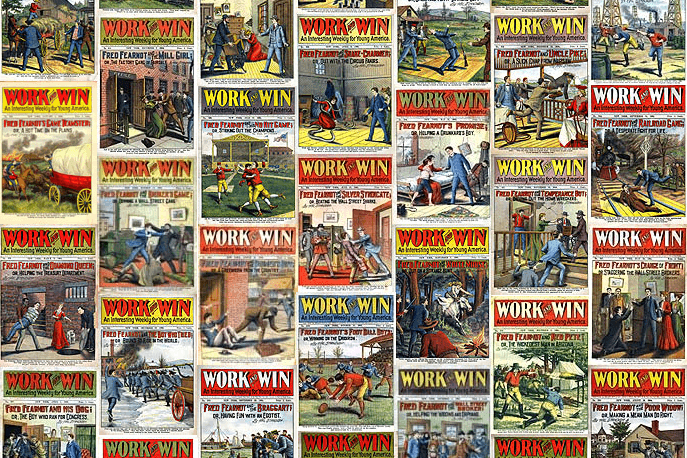
A pulp fiction magazine, dated June 1, 1906, titled “Work & Win” … subtitled “Fred Fearnot and Uncle Josh; Saving the Old Homestead.” The magazine, given to me long ago by my sister Lorinda, is framed next to my desk. I know my sister gave it to me because of “Uncle Josh” … but on the cover, Fred Fearnot grasps the collar of the iniquitous landlord who is about to turn Uncle Josh and his family out into the snowy cold. Fred Fearnot’s words: “You soulless old scoundrel! You shall not take the old homestead from these people.” Fred is my kinda guy.