He was a nice guy who had lived a rough life. You could see it in his face and hands. Some of it was his fault but not all of it. He carried a ballpoint pen and notebook in his shirt pocket and I asked him about it. He said, “Hard as I try, I can’t seem to remember anything good. It’s like I don’t have any good memories. So I’m trying to make some. Every day I try to do something good, something I’ll be happy about. I write those things here in my book so I won’t forget.”
Dismissals
-
-
My parents, married in 1947, bought a working farm. They were not farmers and Nature reclaimed the fields. The barn became my mother’s studio and my father’s study. My sister and I grew up in that quiet realm. When our parents died, we sold the farm to a friend. Recently, I returned to the farm with my wife, my oldest son and his wife. I walked about in near silence, unsure of my own memories. Then my friend bid us sit and brought a pitcher of water from the well. I drank that cool farm water and the memories returned.
-
With the recent spate of gun violence comes a question: “What is to be my response?” Thoughts and prayers alone won’t cut it so I’m considering a one day first aid trauma course. I’d be trained to render immediate care to anyone hurt in any sort of accident … gunshot wounds included. It’s unlikely that I’ll ever encounter a gunshot victim. Still, I’d feel that I had done something … maybe not about about gun violence per se … but to give aid … to relieve suffering … however the suffering comes about … that is no small matter … and it is certainly a Christian vocation.
-
As a boy, I told my father of a perceived injustice, a situation that must straightaway be set to rights. I cannot recall what had me in such a lather, some minor vexation that I had recalibrated into a matter of urgency. I set it all out for my father. I then justified my inability to remedy the situation. I waited to be dismissed with some innocuous advice and a kind word for being such a dear boy. My father paused, leaned toward me and said in an even voice, “Now, tell me what you intend to do about it.”
-
After church, a man asks if I’ll drive him home. “Bad leg. Can’t walk.” I ask where he lives. “We got to go over by the highway.” We drive. Then he tells me to get on the highway. At 70 miles an hour he keeps saying, “Almost there … a little farther … keep going …” I know I’ve been conned but I drive on. Finally, in Lodi, 62 miles from church, he’s home. He says, “Thanks!” and walks off. Still, I feel pretty good about all of it. As I see him walk away, his leg is completely healed … it’s a miracle!
-
I was ten when my dad took me to see the Indians play the Yankees. Mostly, I wanted a player to sign my baseball. My dad was decidedly skeptical. At seventh inning stretch, an important looking man in a dark suit walked by. I said, “Mister! Sign my baseball!” Without a word, he wrote upon it and strode off. Whoever he was, I was one happy kid. Once home, my dad read the name: Phil Rizzuto! The great Yankee’s Hall of Fame shortstop and, later, radio broadcaster had been in Cleveland that day to call the game. You never know!
-
Saturday morning, it was the Jewish Sabbath and I, needing a widget, drove to the Big Box Store. I passed people walking to their synagogues … women in full-length skirts, men in felt hats. I saw a young man, perhaps half my age, in a dark suit, a prayer shawl under his jacket. I felt happy … something there is about witnessing people living their faith. I envied the young man’s studied, quiet demeanor and I reflexively lifted my hand from atop the steering wheel in a silent, private greeting. I thought he would not notice but he smiled in reply.
-
The Deacon’s Dismissals I write every week now number over three hundred. They each allude to the deacon’s (or the priest’s) dismissal at the end of the eucharistic service, “Go in peace to love and serve the Lord.” In the Eucharist, we have met God. Then we go forth to make the world a better place … we are Kingdom-builders, peace-bringers, healers, preachers, prophets, theologians, caregivers, activists, servants and workers of good deeds. We go, a prayer on our lips, to perfect the world and all that is in it. Go in peace to love and serve the Lord!
-
My cousin died leaving her Chow dog, Molly. Her sister, Lee, might have adopted Molly but Molly was too big and rambunctious. Lee found a Chow rescue home a few hours away. At the rest stop, I held the leash as Molly slipped her collar and ran into the dense woods. I was distraught. Lee wept. We called Molly’s name and waited… an hour… then two. We were minutes from pulling away when Molly broke from the woods, happy to see us. Maybe Molly needed some alone time. Maybe Lee, too. Lee said, “Come on Molly, let’s go back home.”
-
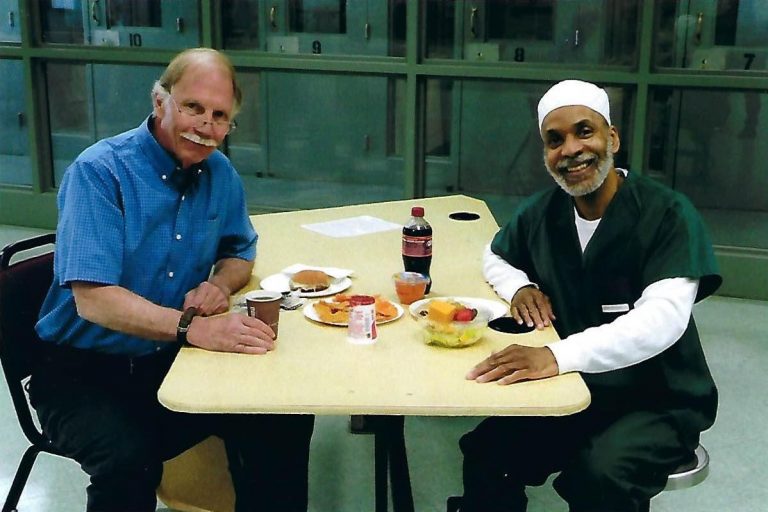
Two men sit at a table, men like any other at a table like any other. One man is a prisoner, chained to the table. The other man is free. One is a Muslim, the other a Christian. The conversation is animated and light. They listen, laugh, reminisce and speak of what might one day be. Before them is a feast from the vending machines … sandwiches, sodas, coffee, an array of chips and sweets. Each man offers a short blessing for the food and for the other. They eat and talk. Time moves quickly until it is time to go.
-
I was barely 21 when I took a notion to buy an old Brinks armored car. It was a lark, nothing I needed, but I set about getting one. I wrote letters and ended up on a long distance, operator assisted telephone call to a man in Texas. He had dozens of old armored cars. The price? Three years of my pay! I asked, “Why so much?” He said, “We do a good business. We convert old armored cars into school buses and limousines for the wealthy, in the cities in Central America, where gangs and kidnappers rule the roads.”
-
Evelyn Underhill (1875 -1941) was an Anglican intellectual, pacifist and writer on mysticism. She once received advice from Austrian religious writer and Christian apologist Friedrich von Hügel (1852-1925) who thought Evelyn too enthralled by ideas: “I believe you ought to get yourself, gently and gradually, interested in the poor; that you should visit them, very quietly and unostentatiously, with as little incorporation as possible into Visiting Societies etc. You badly want de-intellectualizing or at least developing homely human sense and spirit dispositions … I would carefully give preference to the two weekly visitations of the poor above anything else …”* *(From A Mile in My Shoes, Trevor Hudson)