Saturday morning, it was the Jewish Sabbath and I, needing a widget, drove to the Big Box Store. I passed people walking to their synagogues … women in full-length skirts, men in felt hats. I saw a young man, perhaps half my age, in a dark suit, a prayer shawl under his jacket. I felt happy … something there is about witnessing people living their faith. I envied the young man’s studied, quiet demeanor and I reflexively lifted my hand from atop the steering wheel in a silent, private greeting. I thought he would not notice but he smiled in reply.
Dismissals
-
-
The Deacon’s Dismissals I write every week now number over three hundred. They each allude to the deacon’s (or the priest’s) dismissal at the end of the eucharistic service, “Go in peace to love and serve the Lord.” In the Eucharist, we have met God. Then we go forth to make the world a better place … we are Kingdom-builders, peace-bringers, healers, preachers, prophets, theologians, caregivers, activists, servants and workers of good deeds. We go, a prayer on our lips, to perfect the world and all that is in it. Go in peace to love and serve the Lord!
-
My cousin died leaving her Chow dog, Molly. Her sister, Lee, might have adopted Molly but Molly was too big and rambunctious. Lee found a Chow rescue home a few hours away. At the rest stop, I held the leash as Molly slipped her collar and ran into the dense woods. I was distraught. Lee wept. We called Molly’s name and waited… an hour… then two. We were minutes from pulling away when Molly broke from the woods, happy to see us. Maybe Molly needed some alone time. Maybe Lee, too. Lee said, “Come on Molly, let’s go back home.”
-
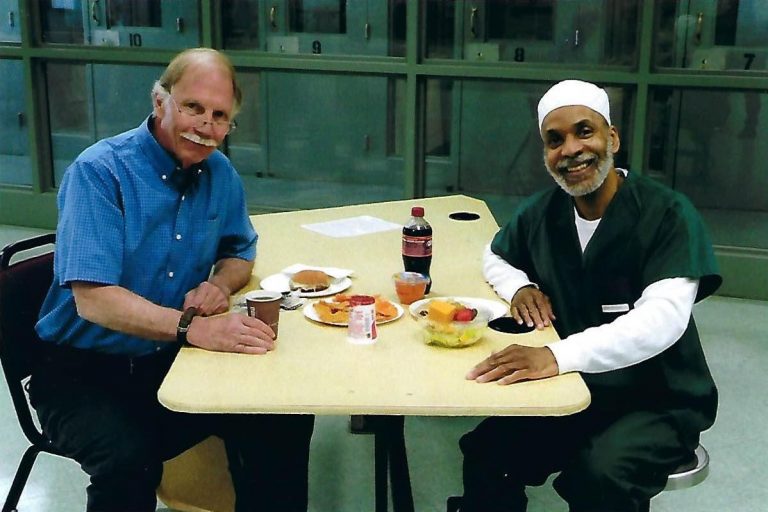
Two men sit at a table, men like any other at a table like any other. One man is a prisoner, chained to the table. The other man is free. One is a Muslim, the other a Christian. The conversation is animated and light. They listen, laugh, reminisce and speak of what might one day be. Before them is a feast from the vending machines … sandwiches, sodas, coffee, an array of chips and sweets. Each man offers a short blessing for the food and for the other. They eat and talk. Time moves quickly until it is time to go.
-
I was barely 21 when I took a notion to buy an old Brinks armored car. It was a lark, nothing I needed, but I set about getting one. I wrote letters and ended up on a long distance, operator assisted telephone call to a man in Texas. He had dozens of old armored cars. The price? Three years of my pay! I asked, “Why so much?” He said, “We do a good business. We convert old armored cars into school buses and limousines for the wealthy, in the cities in Central America, where gangs and kidnappers rule the roads.”
-
Evelyn Underhill (1875 -1941) was an Anglican intellectual, pacifist and writer on mysticism. She once received advice from Austrian religious writer and Christian apologist Friedrich von Hügel (1852-1925) who thought Evelyn too enthralled by ideas: “I believe you ought to get yourself, gently and gradually, interested in the poor; that you should visit them, very quietly and unostentatiously, with as little incorporation as possible into Visiting Societies etc. You badly want de-intellectualizing or at least developing homely human sense and spirit dispositions … I would carefully give preference to the two weekly visitations of the poor above anything else …”* *(From A Mile in My Shoes, Trevor Hudson)
-
Every Friday, I go to the men’s homeless shelter for a few hours. A block away, I always pull over by the railroad tracks to gather my thoughts. Recently, sitting there, a police car pulled up behind me. Two officers wanted to know what I was doing, parked like that. They were pleasant but curious. I told them I was enjoying the day and I’d soon be on my way. One policemen warned me: “Be careful. There’s a homeless shelter just down the road.” I thanked them. They went on their way and so did I, a few minutes later.
-
The usual rigamarole … empty pockets, 20 questions, show ID … then into the prisoner visiting area to see Mike. Prisoners cannot leave their chair so I went to the vending machine to peruse the wilting ham sandwiches, sawdust cookies and limp chips. The woman ahead of me tried for the chips but her card was woefully underfunded. I watched her walk away. I bought the chips, palmed the bag and sauntered nonchalantly to where she sat. It’s strictly forbidden, but I pulled it off … I passed the chips to her prisoner. I returned to Mike. He smiled and said, “Very smooth!”
-
At a conference on racism, on the table before me, a small sign with these words: “… I am responsible for the house I did not build but in which I live.”* I learned much about racism at that conference. More learning lies ahead but that little sign gave me clarity and understanding. Whether it is racism, the degraded environment, muddled politics, or the seeming failure of decency in the world … this time and place is the house where I live … and I will, with God’s help, work to make it a better house. *Dorothee Sölle, 1929–2003, German liberation theologian
-
The grocery checkout line was long. Folks were impatient. The cashier did her best. The old man ahead of me had only a few items. When it was his turn, the cashier dropped his one and only apple. She picked it up and said, “Please, get another.” He went slowly. The line grumbled … “Apple not shiny enough?” … “What’s the holdup?” The old man returned with an apple, handed it to the cashier, then said to those near him in the line, “I’m sorry to be so slow. Thank you for waiting for me.” He paid and left us waiting quietly.
-
As a deacon, I end up in some strange places. When I was ordained, I made promises about what I would do. One promise calls me most clearly … that I am to “… interpret to the church the needs, concerns, and hopes the world.” I knew then that I would not remain in the comfortable church but go out into the world, into the places where the least light shines. I have done that … and I return to you every week to tell of what I have seen … and to ask your help and prayers to make sense of it all.
-
A young man, I attended the Episcopal Church where Father Hutchins was priest. One Sunday, invited to the rectory for dinner, Mrs. Hutchins opened the door. We walked toward the kitchen and there was Father Hutchins, flat on his back on the living room floor, still wearing his collar, eyes closed, listening to Mozart on the stereo. Mrs. Hutchins told me, “Two services this morning, still chores to do and an afternoon of hospital visits ahead.” I walked quietly to the kitchen. I did not understand then about Father Hutchins the floor. But fifty years later? Now I get it.